Overview
|
| Reliable,
high-performance RAID storage is at
the center of digital film and video
postproduction(see Figure 1). As
digital video data-rates grow, the
critical storage characteristics are
capacity and performance/ bandwidth.
Innovations delivered by the PROMISE
VTrak E-Class RAID subsystem solve
many of the storage challenges of
postproduction (post). The capacity
and performance metrics are
exceptional and the modular design
enables projects of all sizes. |
| The
transition to 100% digital workflow
has changed the way productions are
shot, edited and delivered. Storage
technology is one of the enabling
factors. From the production
perspective, digital cameras let
directors get nearly instant
feedback on set. Solidstate camera
media enables non-linear access to
any point in time, eliminating the
need to queue up for the next shot,
like you would with tape formats.
This allows crews to shoot quickly
with higher shooting ratios and
removes time-consuming tasks like
on-set film handling or rush
processing. Ingesting footage into
post has many fewer steps, so rough
cutting can start sooner. From the
post perspective 100% digital means
all of the material will be stored
and transformed on disk. Post
techniques of the past used
expensive singlepurpose edit
stations with small islands of
directattached storage.These are now
replaced with centralized/shared
storage and consumer-off-the-shelf
computers running powerful software.
Centralized storage drastically
improves agility; it also allows
proven enterprise data management
techniques to be used to assure data
availability. |
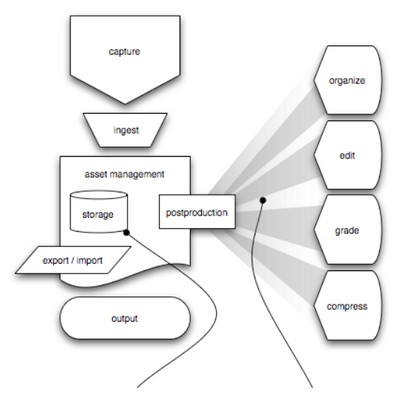 |
|
Capacity |
Performance/Bandwidth |
|
Requirements influence by:
-
Video format
-
Resolution/compression
-
Duration/duplication
-
VFX/compositing/audio
-
Output format
|
Considerations for shared
storage:
-
Number of hosts
-
Concurrent streams
required
-
Read/write ratio
-
Reserved
bandwidth/isolation
|
|
Figure 1: Capacity and
performance/bandwidth |
|
| High quality digital
video files are large (see Table 1).
Video files take up a lot of space
on disk and need fast networks to
support multi-stream playback
without dropping frames. The table
below shows some popular formats
that are used in film and video
production. The popularity of HD and
shift to digital has blurred the
lines between capture resolution and
release resolution, pushing more
productions toward HD capture even
if the project will be used for
lower resolution web delivery.
Once the files are stored on disk,
multiple copies are inevitably made
as the files are processed. Tracking
and managing the files is critical
to project efficiency and crucial
for larger post facilities where
multiple projects use the same
capacity and bandwidth resources. |
|
|
Video format |
Disk space for
2-hours of video |
Data rate
MB/second |
|
SD – ProRes-422 HQ 486i @ 30
fps |
60 GB
|
7.88
|
|
HD – ProRes-422 HQ 1080p @
25 fps |
170 GB
|
23
|
|
HD – Uncompressed 10-bit
1080i @ 30 fps |
1.2 TB
|
166
|
|
2K – 10bit RGB/full frame
DPX |
2.2TB
|
305
|
|
4K – Uncompressed 10-bit DPX |
8.7TB
|
1210
|
| Table 1:
Popular video codecs
|
|
VTrak E-Class Storage
Workflow environments are only as
solid as the foundation they’re
built upon. The VTrak E-Class RAID
subsystem sets the highest standard
for reliability, price, and
performance. VTrak is performance
tuned for the film and video
industry’s best large-file
sequential throughput. With VTrak
E-Class you don’t have to sacrifice
performance for rock solid fault
tolerance and reliability.
Data Integrity Features:
- Redundant battery backup
unit for cache (up to 72 hours)
- APC UPS support – Changes to
cache to write-through during
power outage
- Self-healing with Predictive
Data Migration (PDM) on the
drives
- Dynamic priority control for
background tasks like rebuild or
PDM
|
|
Advanced Video Codecs |
New
digital video formats allow
images to be captured at
virtually film resolutions
and moved from the
camera/media to protected
RAID storage faster than
real-time. Postproduction
software can manipulate many
of the files in the native
camera format. This allows
initial work to begin the
moment the files are on
disk.
By streamlining constraints
at ingest, hours or even
days can be cut from the
postproduction schedules of
the past. |
|
FCP Native Codec Support |
- DVCPRO HD (P2) –
Panasonic
- XDCAM EX – Sony
- AVC-Intra
- AVCHD
- RED (RED plug-in
required)
|
|
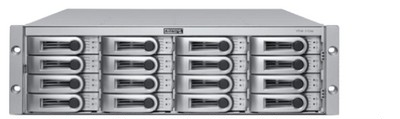 |
| Figure
2: VTrak E-Class front view.
LED indicators display
current system health and
activity |
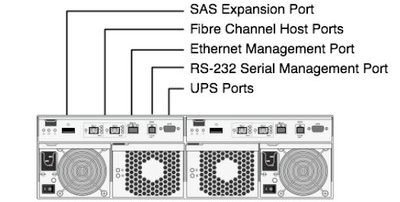 |
| Figure
3: VTrak E-Class rear view.
All components hot-swap. LED
indicators display component
status |
|
Redundant and Active-Active
|
VTrak E-Class has a
No Single Point of Failure (NSPOF)
design with redundant, active-active
RAID controllers (see Figure 3).
This assures access through any
component failure, even an optical
cable break. Active-active means
both controllers work
simultaneously. Under normal
operation performance is optimal
with this configuration. If a
controller were to fail, access from
the failed controller moves to the
surviving controller. All files
remain accessible without
interruption. High availability is
critical to support multi-user
environments where downtime impacts
the whole team.
In some video applications, maximum
write performance is more important
than zero-downtime. VTrak
controllers can be set to operate
independently by disabling cache
mirroring. With this configuration
the user data is securely protected
by RAID as well as a battery backed
cache. If a controller were to fail,
targets can easily be assigned to
the surviving controller since all
drives are accessible to both
controllers. Advanced features, like
Logical Unit Number (LUN) masking,
are provided at no additional
charge. LUN masking allows shared
storage targets and private storage
targets to coexist securely across a
Storage Area Network (SAN). LUN
masking can also be used for smaller
installations to provision dedicated
storage for multiple hosts with a
single VTrak E-Class subsystem.
|
Fibre Channel
Topology
|
For AV applications,
Fibre Channel host connectivity
offers the flexibility to go from a
small direct-attached solution to a
Storage Area Network (SAN) using the
same VTrak E-Class hardware. Fibre
Channel is a mature,
high-performance industry standard,
used in enterprise computing. Like
Ethernet networking, the greatest
benefit of FC is that it can provide
diverse connectivity relationships
that can improve availability and
can effectively scale to meet your
growing needs.
The use of SAN file systems like
Xsan can further expand Fibre
Channel’s scaling capability, by
enabling the storage to be pooled
across physical hardware, providing
both aggregated performance and
transparent expansion to multiple
SAN attached hosts simultaneously.
|
RAID Expansion
|
Capacity Planning
|
| Before
production begins, project
planners should be able to
estimate capacity
requirements for all stages
of the production. The use
of a media asset manager
like Final Cut Server™ from
Apple can improve work
efficiency and capacity
utilization by providing
revision control. Target
capacity utilization should
not exceed 70-80% in AV
environments. |
|
Estimation |
- Program duration
- Capture format
- Shooting ratio
- Ingest ratio
- Visual FX
- Audio production
- Music production
- 2D & 3D Graphics
- Edit reviews &
revisions
- Final delivery
formats
|
|
VTrak E-Class SAS
expansion ports enable the user to
dynamically expand the RAID
subsystem with VTrak J-Class JBOD
expansion chassis (see Figure 4).
Expansion can be done incrementally
as capacity requirements grow or
upon initial deployment to support
larger configurations.
For the large-file sequential
performance needed for video, the
32-drive E+J configuration provides
optimal performance. When additional
capacity is needed deploying another
E or E+J will allow for linear
scaling of performance and capacity.
The VTrak E-Class architecture
supports attaching up to four JBOD
subsystems for capacity applications
like archive and backup. But the
documented multi-user AV performance
32-drive configurations should be
used in AV environments. |
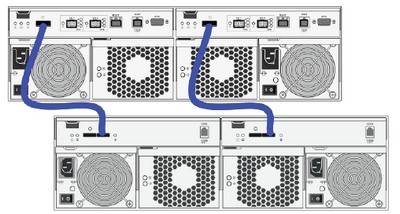 |
| Figure 4: VTrak
E-Class expansion |
|
|
Download AV Postproduction with the
VTrak E-Class RAID Subsystem Guide |


