Introduction
While web-based service
businesses have been around for
over a decade, the scope of
services available has expanded
dramatically to include many
tasks that were once reserved
for local physical hardware.
With the popularity of
notebooks, netbooks and other
thin client wireless computing
devices, the movement of
applications and related data to
a centralized “cloud” is now
widespread. These
cloud/web-based services have
made it easy for the average
user to manage and access their
data from multiple devices,
never having to struggle with
the underlying server and
storage technology.
|
Cloud Storage
For the following example
deployment we will describe
PROMISE storage technology as
the key component to a cloud
providers successful endeavor.
Customers using the cloud
service will be given all the
features of corporate network
storage including a remote copy
of their local “home directory”
without having to purchase
expensive hardware and software.
Other large files like video,
audio and still image files will
be a part of the content stored
and shared using this service.
For the corporate user this
service could take the worry and
expense out of the day-to-day
administration associated with
managing users laptops and
remote office data.
For the home user this
service provides an enterprise
level of reliable storage and
offsite vaulting of their large
files that was previously
unaffordable.
|
Challenges
- Application services
must always be available
(99.999% availability).
- Server architecture
needs to have enough
bandwidth and raw throughput
to support an ever-growing
number of concurrent users.
- Home directory
synchronization must
complete in a reasonable
amount of time (overnight).
- Service provider
administrators need to be
able to manage the whole
operation remotely.
- All interaction with the
service is done through
secure connections.
- All aspects of the
service must scale
transparently without
downtime.
For the service provider
delivering these services, the
IT solution requirements
continue to grow but the goals
remain the same: customer data
must be there when it’s
requested, regardless of
component failure or even
natural disaster. The solution
must deliver consistent
performance reliability and
manageability to support the
Service Levels Agreements (SLA)
between the service provider and
the end customer.
Host-independent high
available RAID storage provides
the foundation for any
mission-critical server-based
business today. The benefit of
host independence combined with
full-component redundancy
insures the data from one server
is easily accessible to others
should the server hardware fail.
Servers with internal RAID
storage simply cannot provide
this level of data availability.
|
Architecture
For the service provider, the
first area of concern on a
public network like the Internet
is security. We would assume
that the storage application was
written to prevent unauthorized
access to the users data at all
stages of the process, as well
as resist hackers both inside
and outside of the provider's
network. Both endusers and
remote administrators must
access the application and
resources through a firewall;
typically an
application-delivery controller
or network accelerator is used
to optimize the application
being provided.
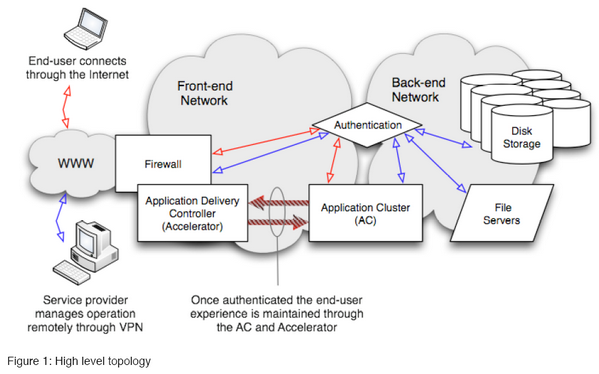
After authentication, the
end-user accesses the service
through a high performance
“front-end” Ethernet network,
which in most cases is logically
and physically separate from the
“back-end” network where the
administrators manage the
service and physical hardware
(figure 1). The servers, VTrak
E-Class storage and other
managed devices have their
Ethernet ports attached to this
“back-end” network. |
|
| With the VTrak management
port connected to the back-end
network, management interfaces
are protected from front-end
traffic and malicious attacks
are virtually eliminated. VTrak
uses secure socket layer (SSL)
technology on WebPAM PRO, its
browser-based user interface and
Secure Shell (SSH) technology on
its Command Line Interface (CLI),
enabling administrators to
manage the storage hardware
remotely with full 128-bit
encryption end-to-end. The
next step in planning the
deployment is to understand the
data processing requirements at
each
functional stage to determine
the optimal choice of hardware
and software to deliver reliable
service, in order to meet
customers' needs and keep their
business. |
|
Download Cloud Storage Guide |


